


When I first read about the PayPal investment case I thought to myself: “I don’t want a binary situation where I put my chips on either ‘market is wrong, model prevails’ or the total disruption of the business model.” I parked it several times because it was not my game. But, for me, the current thesis sounds more like an industrial player navigating competitive pressures through cost containment and good capital allocation. And this is my game.
After months of work, here it is: the full thesis, together with the Excel model behind it. You can pivot TPV growth, take rate, expenses and multiples, and build your own scenarios. If you think I’m too optimistic or too cautious, test it yourself.
On my side, now that the full analysis is completed, I’m building a position of up to 7-8% in the managed portfolio.
With this launch, and because PayPal is a name many of you know, I’m opening the Pond until December 26:
Monthly plan at $55 (instead of $100), so you can open the box, read PayPal and the rest of the theses, and decide.
25% off the annual plan with this ➡️ link.⬅️ That’s $375 for the year, about 7 months of the monthly plan.
After December 26, both offers are gone: the monthly plan goes back up and the annual discount disappears.
The 5-minute drill is below, free for everyone. The full thesis and the model are for paid subscribers.
5 minute drill
For years, PayPal was meant to be the global intermediary for online shopping. A web Visa or Mastercard on steroids, because it could also be used as a deposit wallet. In fact, until 2022, the market gave PayPal the same premium as Mastercard: 30-32x PE. Now it trades at 9-10x current earnings, and the growth narrative has turned into a stagnation one.
Three main causes here: (1) The emergence of new payment methods from hardware owners like Google or Apple Pay, (2) the improvements in two-factor authentication of traditional banks (among other payment solutions), and (3) the vertical integration up to the checkout of Shopify, Amazon and other trusted e-shops have drowned the growth model that relied on being the source of trust for consumers in unknown ecommerce sites. In other words: the “Pay with PayPal” button loses its moat.
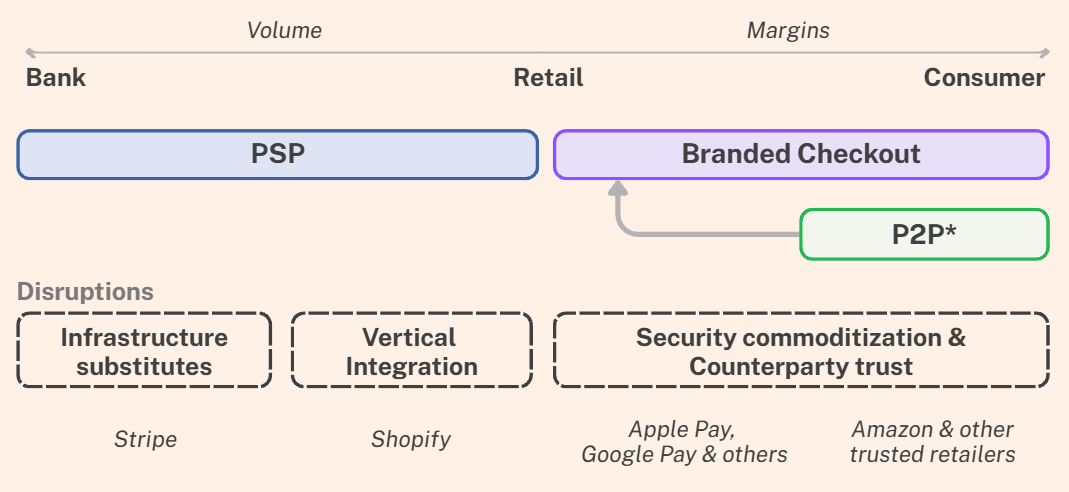
Nevertheless, PayPal is processing 40% more payment volume than in 2022. Why?
The growth now is on the dark side of ecommerce. PayPal is growing in other businesses like Payment Service Provider (PSP), where the competition is on prices, or Peer to Peer (P2P) like Venmo, whose profitability depends on additional services around the ecosystem. In simple terms, PayPal is moving more dollars but taking less on each. Does it make sense to gain volume when you have a structure that you can leverage despite the margin drop?
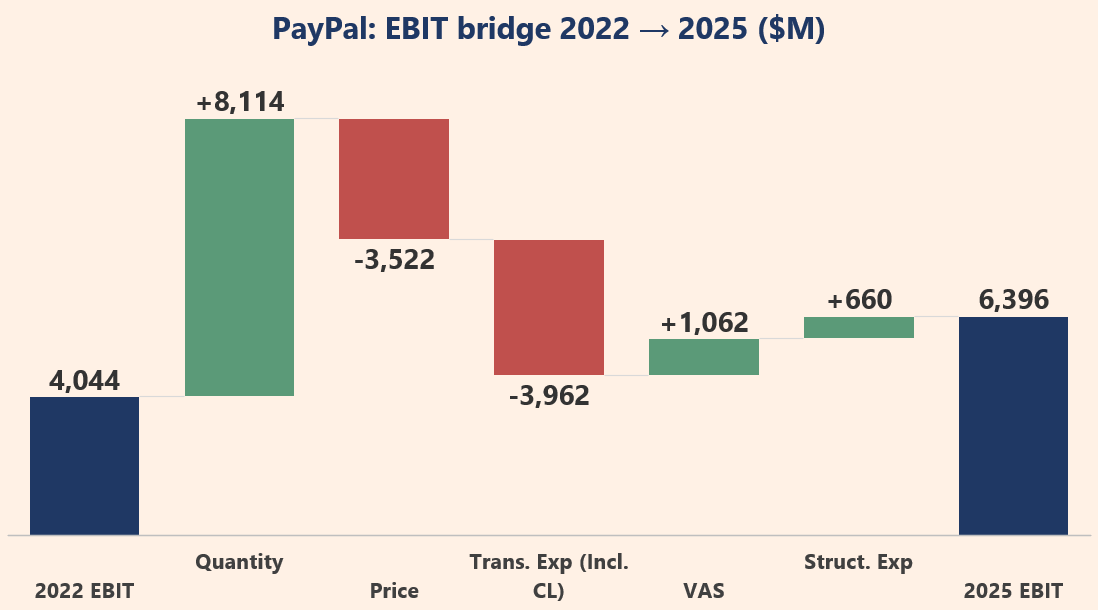
So far, the answer is YES. Some numbers: PayPal generated $4 billion EBIT in 2022 against $6.4 billion in 2025, ↑60% based on a positive quantity-price effect, additional services and operating leverage of structural expenses. In this period, the company repurchased 16% of shares in circulation (net of SBC), more than doubling EPS.
Despite the numbers, the market is worried about the decline in take rates for a good reason: it is difficult to separate the wheat from the chaff, and the declining trend taken to its limit would lead to no terminal value. The narrative has some extrapolation bias and assigns no capacity to the company, but this is not realistic. PayPal has three levers to protect the take rate:
Branded checkout: revitalizing growth through financial services, such as ‘Buy Now Pay Later’ for consumers and working capital and business loans for sellers. These are arguments for merchants to keep the button, even when Shopify owns the checkout. PayPal owns the data of both legs of the transaction and keeps customers’ money in its wallets.
P2P monetization: Venmo, with more than 69 million active accounts, is the gate for younger generations. Today they split bills for free; tomorrow they pay online and in stores with Venmo.
PSP rationalization: after the volume-at-all-costs strategy of 2023, the company is renegotiating low-margin contracts. Less volume growth, but better quality.
Then: PayPal doesn’t need to grow to be undervalued. The company generates $4-5 billion of FCF, an 8-10% yield at current prices, and holds $8 per share in financial assets. With the existing buyback program, that yield rises to 10-12% by 2028-2029, without assuming any recovery in the take rate. That’s the floor. Everything else is optionality.
The full thesis, valuation, sensitivity analysis and a live Excel model with every assumption exposed are available for paid subscribers. The same research I produce for family offices, now available here. If this is the kind of research you were looking for, this is the moment.
Thanks for reading the Value Pond🦆. If you enjoyed it, don’t forget to leave a like 👍subscribe🖊️ and share🔄 it.
DISCLAIMER: All the information provided in this document is purely informative and does not constitute a buying recommendation (according to Spanish Law Article 63 of Law 24/1988, of July 28, on the Stock Market Regulator, and Article 5.1 of Royal Decree 217/2008, of February 15). DuckPond Value Research is not responsible for the use of this information. Before investing in a real account, it is necessary to have the appropriate training or delegate the task to a duly authorized professional.
Reach us on duckpond@duckpondvr.com