


Good afternoon dear reader,
Often you pass on a company not because it's necessarily bad, but because there are already too many expectations priced in. That happened with Dunelm. Even though it had corrected, on slightly lower growth expectations and the Iran war, the predictability of its cash flows and its high dividend kept it trading at levels that offered no margin of safety..
Often you pass on a company not because it's necessarily bad, but because there are already too many expectations priced in. That happened to me with Dunelm. Even though it had corrected, on slightly lower growth expectations and the Iran war, the predictability of its cash flows and its high dividend kept it trading at levels that offered no margin of safety.
A friend and subscriber pointed me toward Vusion, a French company focused on improving retail productivity, and from the outside there were a few elements that caught my attention and justified digging in deeper.
The analysis turned up a few red flags, which I'll walk through today. Note: this isn't a bearish call, nor a critique of the business model, which I haven't dug into deeply enough to judge, though I will say it raises more questions than it answers for me. Let's get into it.
Internet of Things
Vusion's business model is deploying electronic shelf labels (ESL) in retailers, followed by a subscription to a Cloud platform that allows retailers to reprice on the fly, hourly pricing, declining prices for perishables, or launching campaigns like Black Friday within minutes. On top of that, they've added other services, like micro-cameras that track a shelf for stockouts or consumption pattern detection.

In the early steps of the analysis, the idea looked promising: is this a SaaS company being unfairly punished by the market? If so, the idea seemed compelling: a traditional SaaS isn’t as disruptible as one whose hardware is physically installed across thousands of a client’s shelves, with a fairly low unit cost per label but a high, though finite, switching cost (label battery life runs 5-10 years depending on how often prices change).
The problem I ran into, and the reason I don’t think it’s worth extending the analysis further, gives this post its title: Walmart’s shadow is too long.
Walmart’s long shadow
Vusion's most important milestone of the past few years came in 2023 with a billion-dollar contract with Walmart, to equip its 4,600 US stores with over 500 million ESL tags, later connected to Vusion's cloud to generate recurring revenue.
The contract was of such a scale for Vusion that Walmart had to prefinance capacity expansions, and the incentive structure of the deal included warrants in Walmart's favor, triggered starting at a $700 million investment threshold and maxing out at $3,000 million, where Vusion would grant 1.76 million warrants at a strike price of €112.20 (of which 73% have already vested and 37% have been exercised).
Thanks to that warrant structure, it's been possible to estimate the revenue Walmart has generated, since the company hasn't reported it directly, and its scale can be seen in this chart:
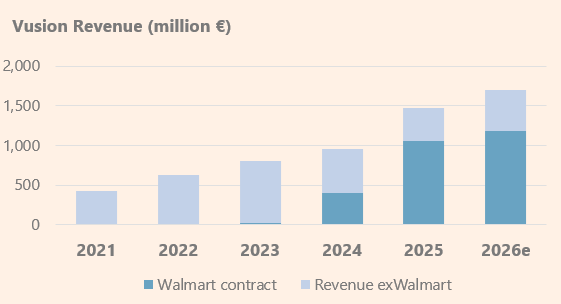
With a revenue base of €800 million in 2023, the Walmart contract essentially doubles annual revenue over 4 years (averaging the heavier deployment years of 2025 and 2026, with the phase-in of 2024 and phase-out of 2027). But it leaves us with two uncomfortable data points:
Ex-Walmart revenue declined more than 20% annually in 2024 and 2025.
In 2027, Walmart's revenue will be 1/4 of what it was in 2026.
The company has been announcing new deployment agreements with strong clients, mainly in EMEA, notably Carrefour (France), with the rollout starting in France, and Morrisons in the UK. In the RoW region, Walmex (Walmart Mexico) stands out, which, as a Walmart subsidiary, is itself a good indicator of satisfaction with the US implementation.
The problem is that, between these three major clients, they can't offset even half of the revenue drop that the end of the Walmart contract represents.
Let's run the Carrefour numbers: Carrefour's hypermarkets average around 8,000 sqm, versus Walmart's 12,000-13,000 sqm (roughly 75% of Walmart's stores are hypermarkets). Carrefour's superstores average around 2,000 sqm. The group has 325 hypermarkets and 1,167 superstores in France. The order of magnitude in total retail floor space is roughly 1:10.
In favor of this contract, unlike Walmart, Carrefour will incorporate other technologies beyond tagging, such as Captana (miniature cameras that monitor shelves), so recurring revenue per store and implementation revenue could be higher. We'll factor that in.
It's also possible that this rollout could open the door to expanding across the rest of its European stores (in fact, a 3-year exclusivity has been signed), though that wouldn't materially change the conclusions, since most of the addressable market is in France.
Let's approximate some numbers, with the usual caveats given the limitations of the company's disclosures, and keeping in mind that the Carrefour contract will carry better pricing and deeper implementation than Walmart's:
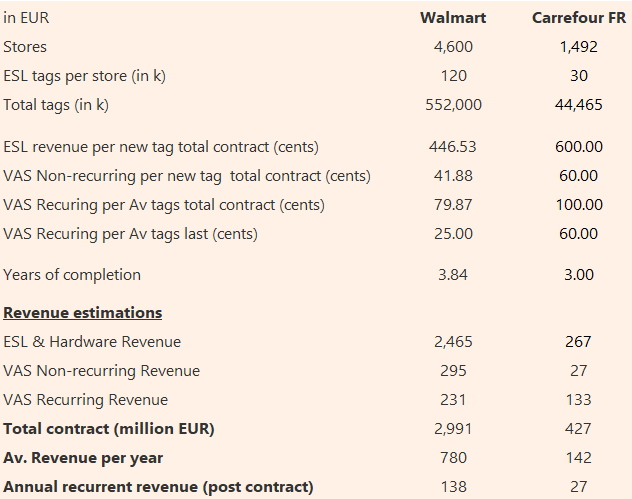
This estimate carries even more weight as the high end of the range when we read Carrefour's 2025 annual report.
“The Group will invest 100 million euros a year in AI and roll out the Vusion platform across all its French hypermarkets and supermarkets to optimise shelf management and online order preparation.”
Carrefour 2025 Annual report
Assuming they invest 100% of that into Vusion, my estimates are still on the optimistic side.
Walmex and Morrisons would each account for roughly 1/3 of what the Carrefour France contract represents, so together they replace at most 25% of Walmart's revenue. Walmex's contract could be followed by one for the Bodega Aurrera stores, also owned by Walmex, which is undoubtedly a vote of confidence in Vusion, but still falls well short of a sufficient replacement.
The full numbers, both for the rest of the contracts and for how I estimated the Walmart contract, are available in an Excel file for premium subscribers.
Other unavoidable realities
VAS recurring revenue concerns
One of the company’s expectations is that its installed base of electronic labels will layer on additional recurring revenue tied to their connection to Vusion’s cloud. This is what they call VAS (value-added services) recurring revenue.
Currently, this revenue accounts for just 10% of sales, and its scalability raises some doubts for me:
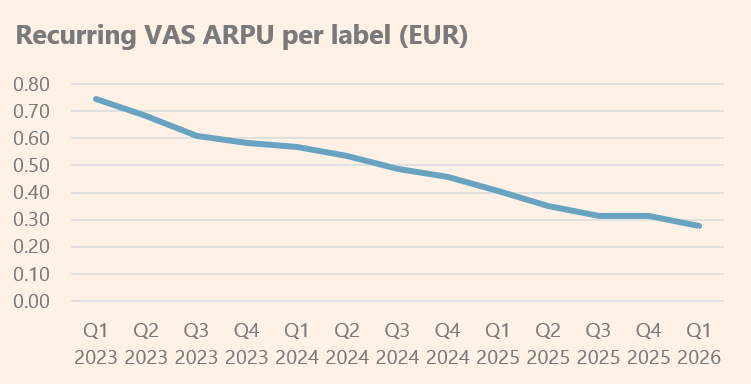
As of the end of 2025, of the 650 million tags installed by the company, around 375 million were connected to the Cloud service. Of those, roughly 276 million (74%) belong to Walmart. Many clients bought tags without connecting them to the cloud, so they don't generate recurring revenue. With recurring revenue at just 9% in Q1 2026, it's hard to call this a software company.
As more of Walmart's connected tags have come online, recurring revenue per tag has fallen. The company's 2027 target is to double it.
Cash flow concerns
In 2023 and 2024, the Walmart contract generated incoming cash flow through advance payments on the order book and prefinancing for production lines, but in 2025 and 2026E the company now owes service delivery against those liabilities. In 2024, Walmart had advanced around $800 million in prepayments for the 2025 rollouts, plus $300 million in production-line pre-financing.
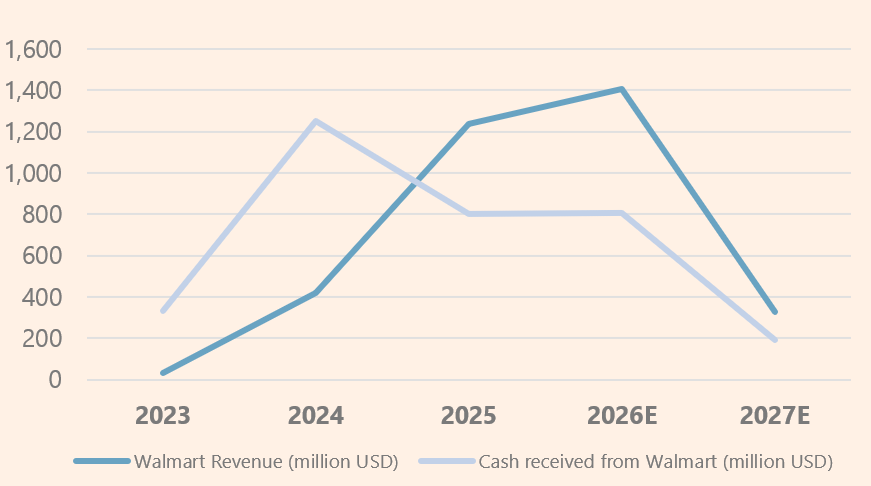
That effect reverses in 2026: based on my calculations, with roughly 50% of stores still to be equipped, Vusion will need to deliver services valued at $1,400 million against a cash inflow of around $800 million. This comes down to two effects: it draws down prepaid credit, and prepayments shrink for 2027, since the remaining rollout will be residual.
Looking at 2026 deliveries ($1,400 million) against an approximate variable cost of around €980 million, versus a cash inflow of €700 million (the $800 million mentioned above), there's a gap of €280 million, which the company's €439 million cash position can cover, but which erodes it.
All in the price, nothing outside of it.
Starting from Walmart's phase-out in 2027E, where its revenue drops from ~€1,100 million to ~€300 million, let's assume the rest of the ex-Walmart client base grows at 20% annually, which is what's implied by the company's 2026 guidance excluding Walmart, and another 20% in 2027. That leaves 2027 with a revenue decline of ~45% versus 2026.
Assuming that, thanks to software margins and additional services, they hit their 2027 EBITDA target (22%), that would roughly double net margin, which, given the sales decline, works out to around €6-7 per share, or a P/E of 20x at a €120 share price.
To me, it's clear: there are too many expectations priced in, with no margin of error left outside of it.
Latest on the Value Pond
🔓 Bayer AG (ETR: BAYN) - Update. The June 25th Supreme Court ruling neutralises the failure-to-warn claim behind most Roundup cases, pushing the $7.25bn settlement closer to reality.

🔒 Associated British Foods (LON: ABF) — Full thesis. Primark alone may be worth the entire group’s market cap, with the announced spin-off as the catalyst. Grocery, Ingredients, Sugar and Agriculture come effectively free.

🔓 Semapa (LSI: SEM) — Net cash, listed assets, a 49% discount to NAV, and a controlling family that already tried to take it private once. The signals point to a second attempt.

🔓 The Pond Tracker | Apr ‘26 — Portfolio review across all active theses.

Thanks for reading the Value Pond 🦆. If you enjoyed it, don’t forget to leave a like 👍 subscribe 🖊 and share 🔄 it.
DISCLAIMER: All the information provided in this document is purely informative and does not constitute a buying recommendation (according to Spanish Law Article 63 of Law 24/1988, of July 28, on the Stock Market Regulator, and Article 5.1 of Royal Decree 217/2008, of February 15). DuckPond Value Research is not responsible for the use of this information. Before investing in a real account, it is necessary to have the appropriate training or delegate the task to a duly authorized professional.
Reach us on duckpond@duckpondvr.com
I'm even more excited to see what happens on July 30—then we'll all know more. Thanks for sharing your perspective!
Very interesting business, nice overview!